A Critical Estimation of Ideological and Political Education for Sustainable Development Goals Using an Advanced Decision-Making Model Based on Intuitionistic Fuzzy Z-Numbers
DOI:
https://doi.org/10.59543/ijsdg.v1i.14193Keywords:
Intuitionistic fuzzy set; Z-numbers; Intuitionistic fuzzy Z-numbers; multi-attribute decision-making; Ideological and political education; Sustainable development goals.Abstract
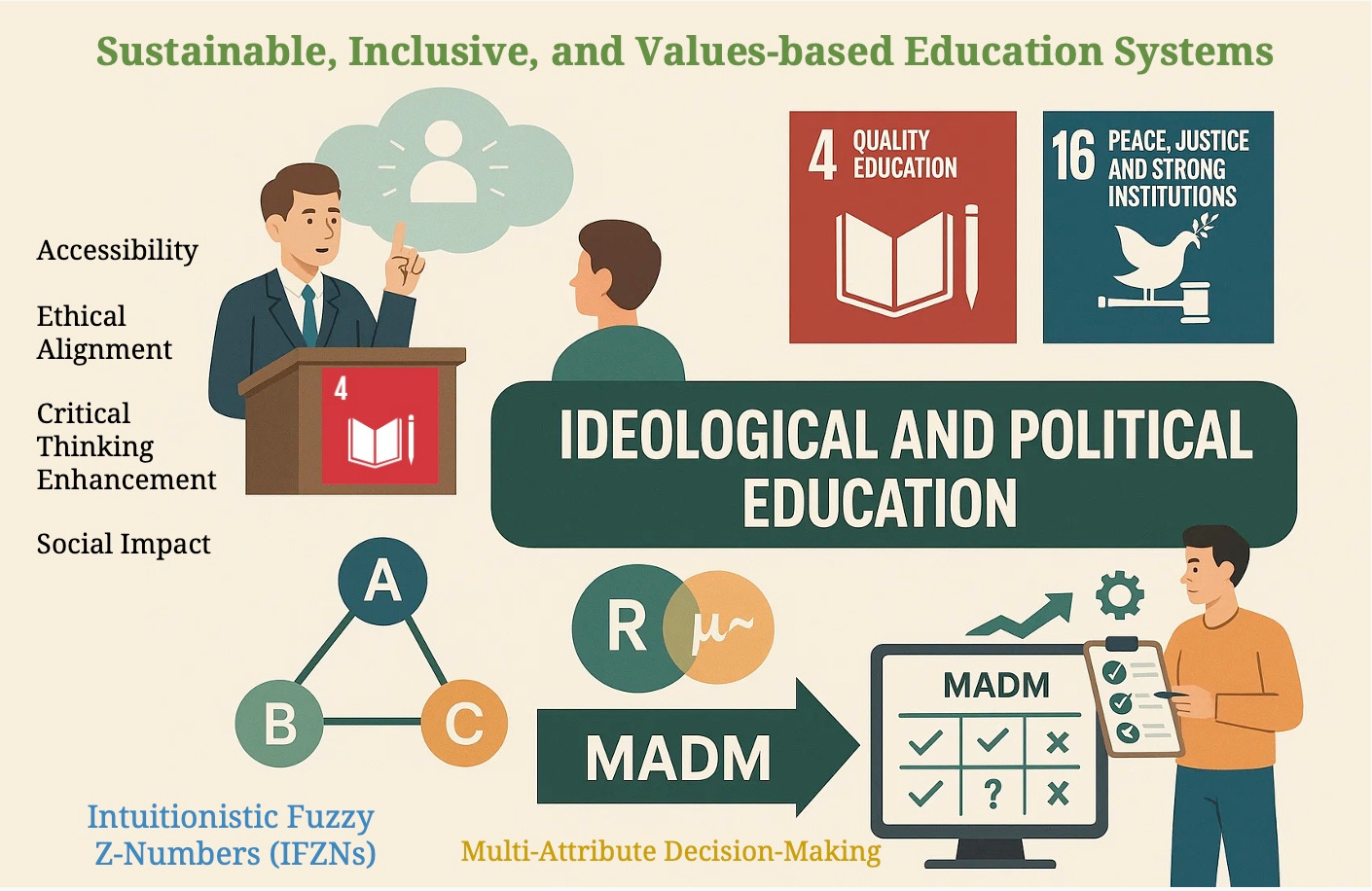
Ideological and political education plays a critical role in fostering informed, responsible, and ethically grounded citizens, directly contributing to Sustainable Development Goals such as Quality Education (SDG 4) and Peace, Justice, and Strong Institutions (SDG 16). However, evaluating the educational strategies in this domain often involve complex, uncertain, and subjective judgments. To address this challenge, this study introduces a robust multi-attribute decision-making (MADM) framework leveraging Intuitionistic Fuzzy Z-Numbers (IFZNs), which effectively handle ambiguity and reliability in human evaluations. We propose novel mathematical operations using triperidol intuitionistic fuzzy weighted average operators to aggregate IFZNs under both restriction and reliability components. This framework enhances transparency, inclusivity, and objectivity in policy and curriculum design. A real-world application is demonstrated through a case study that evaluates advanced educational strategies based on diverse attribute information such as accessibility, ethical alignment, critical thinking enhancement, and social impact. Comparative analysis confirms the model's superiority over conventional MADM techniques. This work concludes with insights on implementation, limitations, and directions for future interdisciplinary research, supporting broader agenda of sustainable, inclusive, and values-based education systems.