Integrating Multi-Criteria Decision-Making and Geographic Information Systems in Landfill Site Selection: A Comprehensive Review
DOI:
https://doi.org/10.59543/ijsdg.v1i.15325Keywords:
Municipal Solid Waste (MSW); Multi-Criteria Decision-Making (MCDM); Geographic Information System (GIS); Analytical Hierarchy Process (AHP); Weighted Linear Combination (WLC); fuzzy logic; landfill site selectionAbstract
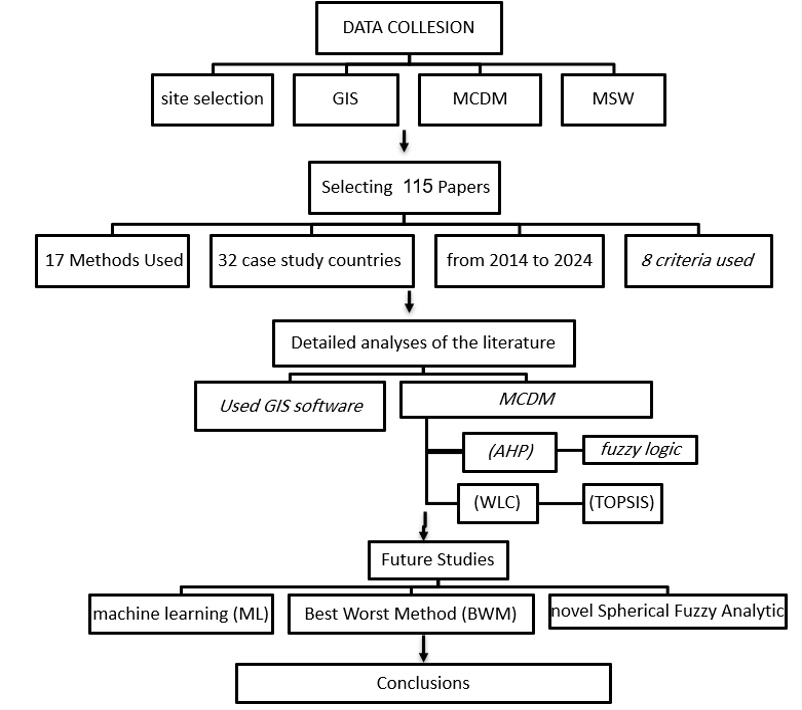
Landfilling is one of the most affordable and appropriate ways to dispose of Municipal Solid Waste (MSW). However, because it depends on social, environmental, technical, economic, and legal aspects, deciding where to put landfills is a challenging and complex undertaking. Over the years, professionals have investigated and used the Geographic Information System (GIS) and Multi-Criteria Decision-Making (MCDM) combinations to address the aforementioned landfill site appropriateness study difficulties. The high quantity of scholarly papers that have been announced for the foreseeable future makes this fact clear. A state-of-the-art of current studies is essential for guiding colleagues and providing a context of the available literature. Reviewing all scholarly publications on GIS-based MCDM modelling for landfill site suitability evaluations is the aim of this project. We have compiled and surveyed 115 studies that were published between 2014 and 2024. A developed taxonomy that includes the following categories—GIS software, application area, uncertainty, MCDM approaches, cell sizes in GIS, and criteria—is then used to examine and categorize the studies. The most popular MCDM techniques for weighting the criteria and ranking the alternatives are the Analytical Hierarchy Process (AHP) and Fuzzy Logic. In contrast, the Environmental dimension is the most frequently favoured primary criterion, and criteria analysis reveals that surface and ground water, geology, among other criteria groups, the most often utilized ones include land use, distance to a fault zone, distance to an urban region, and distance to a road and slope. In addition to offering insights for upcoming modelling and research initiatives in the subject, these classifications and observations are useful for locating study gaps in the existing literature.