Bridging Inequality: Contemporary Challenges to Achieve Sustainable Development Goals Across and Within Nations
DOI:
https://doi.org/10.59543/ijsdg.v1i.16131Keywords:
SDG 10; Global and Within-Country Inequality; Digital Divide; Fiscal Policy; Social Protection; Inclusive Governance.Abstract
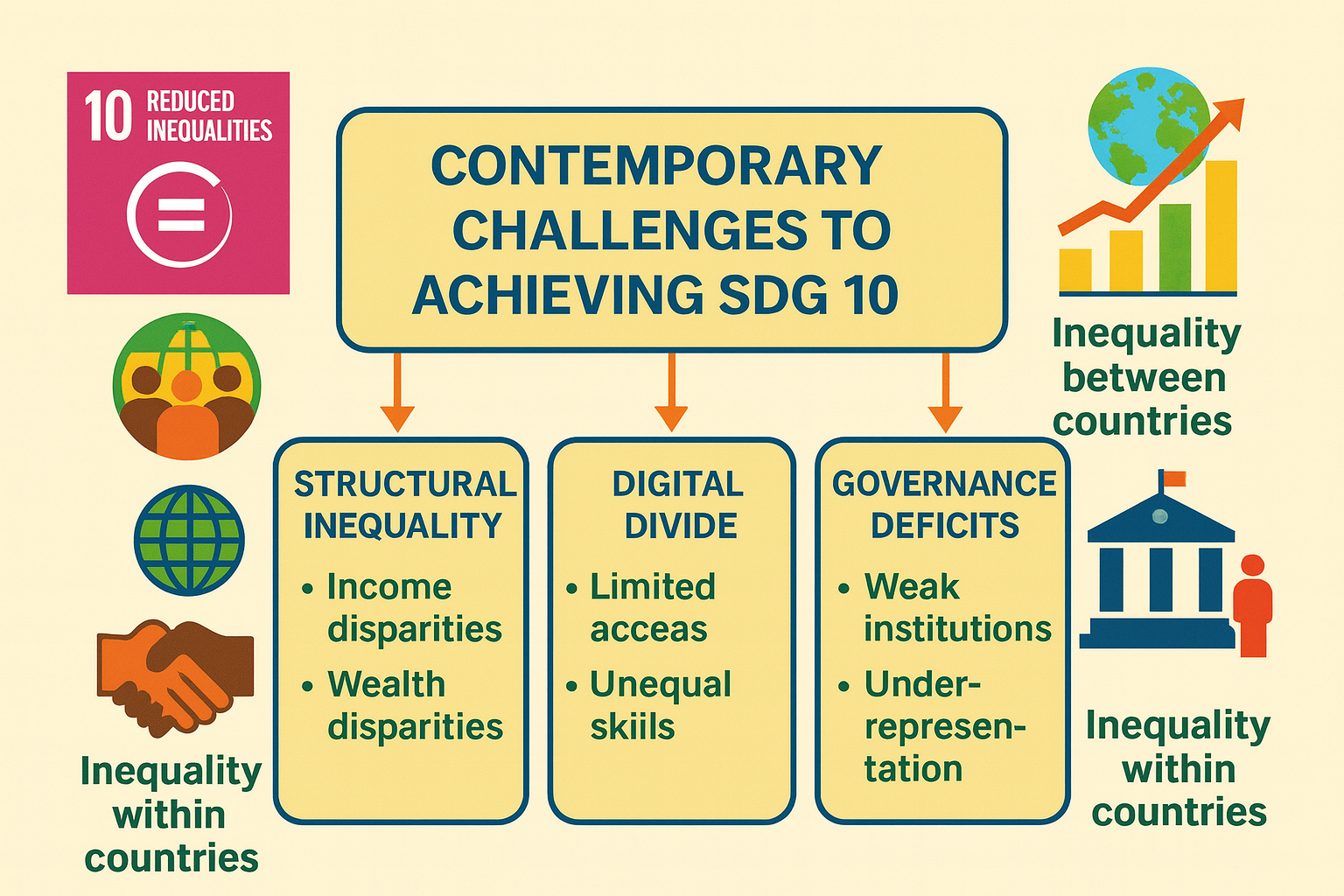
Reducing inequality within and among countries is central to the 2030 Agenda, yet progress has slowed and, in some areas, reversed. This article examines current challenges that complicate the pursuit of SDG 10 and proposes policy directions that are empirically based and people centered. The challenge is double-pronged: the persistent within-country income and opportunity disparities and differences in progress among countries, both aggravated by recent shocks and structural headwinds. The aim is to synthesize evidence concerning current barriers of significance; macroeconomic stagnation and debt distress, the multi-dimensional digital divide and differences in AI diffusion, fiscal under-capacity and weak redistribution, spatial and demographic inequalities, and the under-representation of developing countries in global governance; and surfaces practical levers capable of bridging these gaps. Minutes and methodology, a narrative, policy-oriented review of peer-reviewed research and authoritative international reports, mostly dated between 2022 and 2025, is conducted, complemented with illustrative examples. Principal outcomes indicate five cross-cutting domains of challenge: (i) slower growing and shocks repeated which disproportionately impact the lower 40 percent, (ii) digital access, skills and uses which widen outcome differentials, especially for learners, workers and small firms, (iii) fiscal systems constrained and often regressive limiting redistributive effort and resilience, (iv) spatial, gender and age inequalities compounding disadvantage and (v) governance differences which impede fair voice and allocation of resources. Major conclusions fix upon an integrated policy mix – progressive and efficient taxation allied to social protection and universal basic services, digital inclusion beyond access which guarantees meaningful use, pro-poor, climate-resilient investment and reforms enabling enlargement of inclusion in settings of international rules.