Integrating Analytic Hierarchy Process and Parsimonious Preference Information for Socio-Economic Sustainability Assessment in Urban Public Transport
DOI:
https://doi.org/10.59543/ijsdg.v1i.17011Keywords:
Public Transport; Sustainability; Multi-Criteria Decision-Making (MCDM); Analytic Hierarchy Process (AHP); Parsimonious Analytic Hierarchy Process (PAHP); Socio-economic Indicators.Abstract
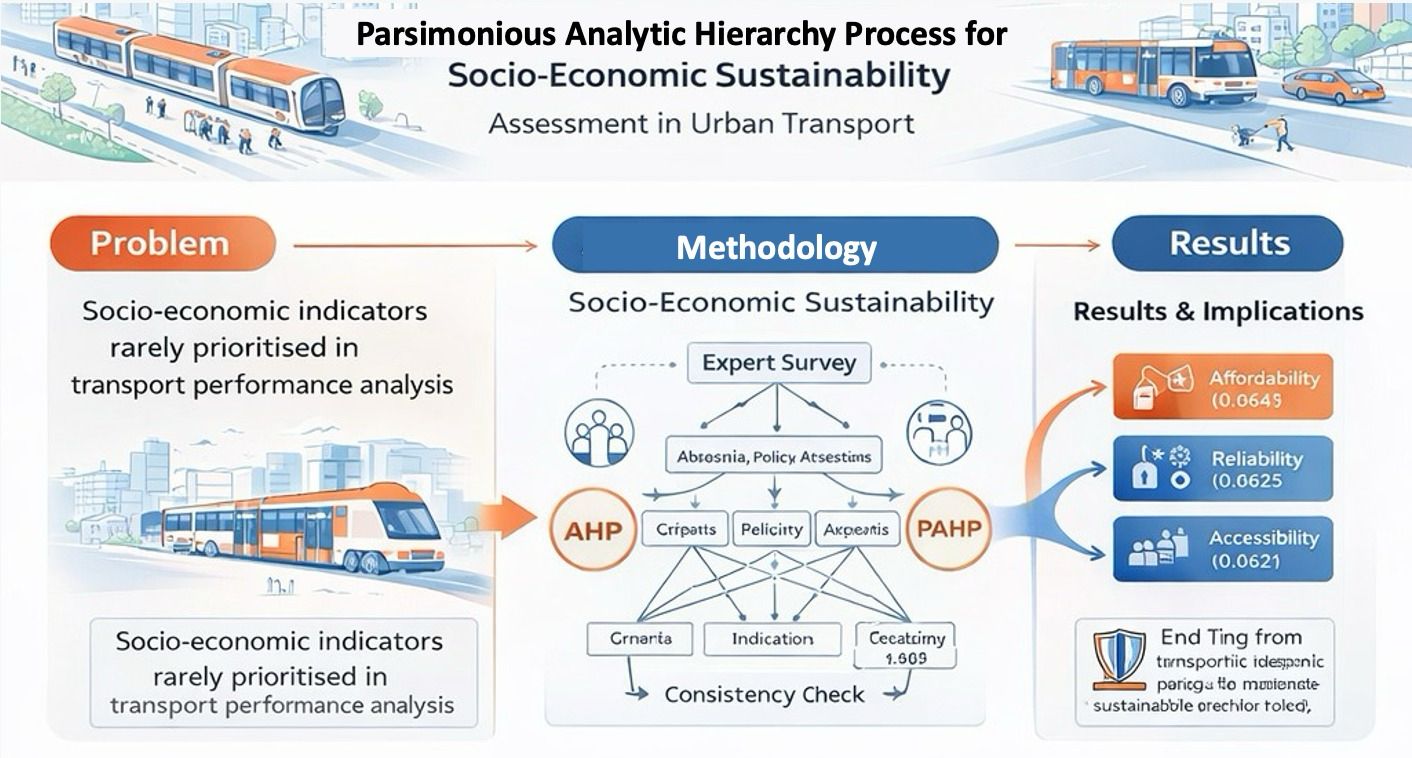
This study integrates the Analytic Hierarchy Process (AHP) and Parsimonious Preference Information to present a structured multi-criteria decision-making (MCDM) framework for assessing the socio-economic sustainability of public transport systems. Despite extensive research on technical and environmental transport performance, few studies have systematically prioritised socio-economic indicators using expert-based MCDM approaches. This study addresses this gap through a survey of 45 transport experts representing academia, policy, and operations. To determine their relative importance, a total of 21 indicators were first evaluated and normalised. The three most important variables affecting user satisfaction and system effectiveness were found to be Affordability (0.0645), Reliability (0.0625), and Accessibility (0.0621). In contrast, Education Level (0.0147) and Gender (0.0102) were the least prioritised. Pairwise comparisons between representative indicators were performed using the PAHP approach, which was verified by consistency ratio tests. This resulted in reliable final weightings by linear interpolation. The results show a strong emphasis on operational and economic criteria, suggesting potential gaps in stakeholder viewpoints and the need for more inclusive assessment frameworks. The results provide policymakers with practical advice on how to prioritise affordability-focused and user-centred service enhancements in order to increase the social sustainability of urban transport. Future research should incorporate environmental and technical sustainability aspects to develop a thorough evaluation model and address the study's expert-centric scope, context-specificity, and lack of behavioural data.