Towards Sustainable Food Choices: Analyzing the Knowledge–Practice Gap in Food Labeling among University-Educated Consumers in Alexandria, Egypt
DOI:
https://doi.org/10.59543/cjzt8517Keywords:
Food labeling, Sustainable Development Goals, Egypt, Consumer awareness, Policy intervention, Sustainable globalizationAbstract
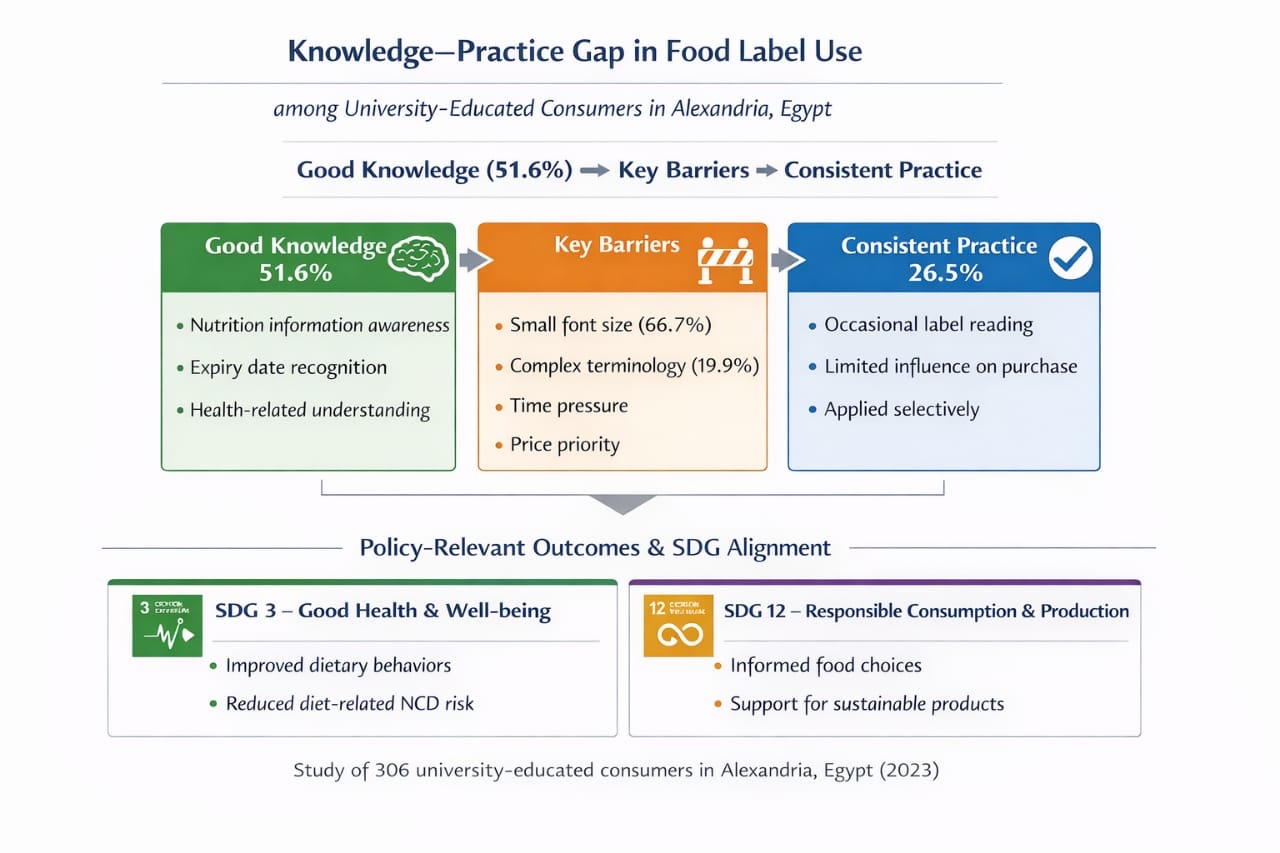
This study investigates the food labeling knowledge–practice gap to provide actionable insights for advancing Sustainable Development Goal 3 (Good Health and Well-being) and Goal 12 (Responsible Consumption and Production) among university-educated consumers in urban Egypt. A cross-sectional survey of 306 adult shoppers revealed a pronounced discrepancy: while 51.6% demonstrated good nutritional knowledge, only 26.5% consistently applied it through label use. Key barriers included small font size (66.7%) and complex terminology (19.9%). Knowledge significantly correlated with practice (r = 0.531, p < 0.001), with higher engagement among females, younger adults, and graduates. These results highlight the critical need for policy-driven solutions—such as interpretive front-of-pack labeling and targeted literacy programs—to effectively bridge this gap, thereby promoting sustainable consumer choices and supporting national public health objectives.
Downloads
Published
How to Cite
Issue
Section
License
Copyright (c) 2026 Yomna Ebrahim Elhelbawy, Adel Abd El-Halim Omara, Ebtisam Mohamed Fetohy (Author)

This work is licensed under a Creative Commons Attribution 4.0 International License.