Mapping the Path for Municipal Solid Waste Management in Libya: A Systematic Review towards a Circular Economy
DOI:
https://doi.org/10.59543/3pjp8y53Keywords:
Urban Sustainability; Circular Economy Pathways; Strategic Waste Governance; Sustainable Development Goals (SDGs)Abstract
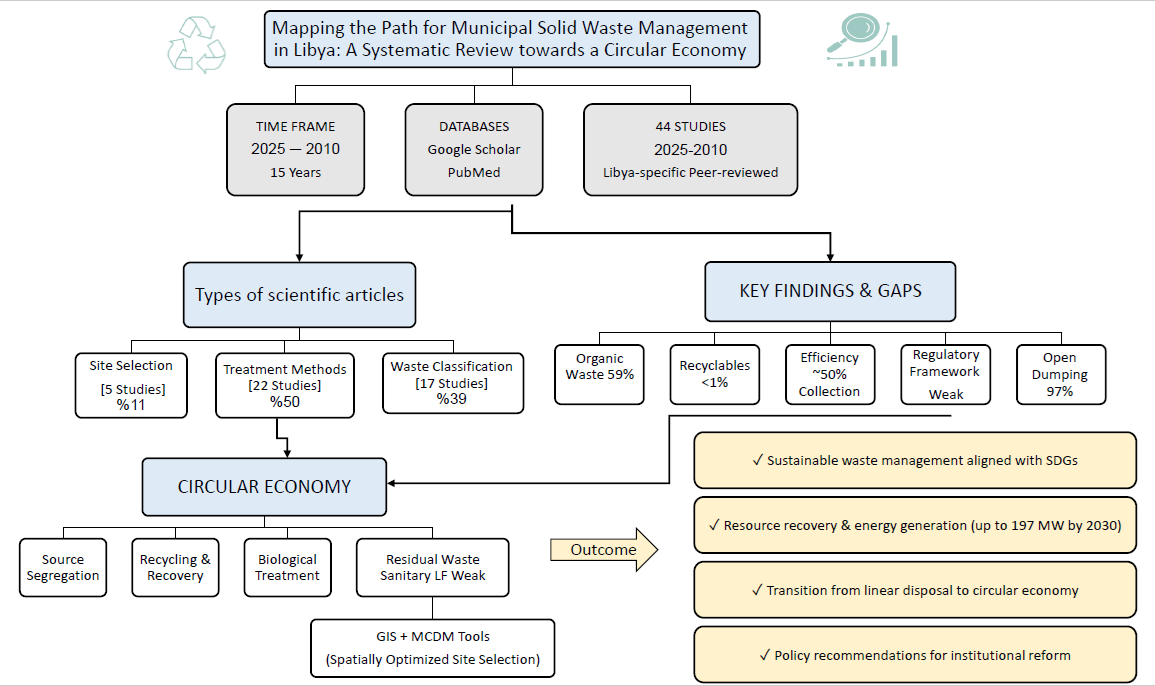
Globally, managing municipal solid waste (MSW) is a major environmental problem, especially in emerging countries where urbanization and population increase are accelerating. This problem is made worse in Libya by inadequate infrastructure, which results in a significant reliance on unsustainable disposal techniques. Based on a review of forty-four publications studies conducted specifically within Libya, this literature review offers a thorough systematic overview of available research on solid waste management in Libya from 2010 to 2025. The study highlights the primary obstacles Libya has in this area, such as the country's fast urbanization, inadequate infrastructure, and reliance on unsustainable methods like uncontrolled landfilling. Although waste-to-energy conversion has been shown to have potential, there are still large implementation and feasibility evaluation gaps in all of the analyzed studies. However, because burning and open dumping still predominate, this potential is still mostly untapped. Public participation, infrastructure investment, and coordinated policies are necessary to fully utilize Waste to Energy (WtE). The findings indicate that the majority of current research concentrates on waste categorization and preliminary analysis (50%) and treatment technology studies (39%), with less attention paid to studies on choosing appropriate landfill locations (11%). This shows that there is a glaring research gap in connecting primary data to real-world applications. In order to enable the creation of a sustainable and successful waste management plan for Libya, the article suggests adopting integrated research that links waste characteristics with suitable treatment technologies and site selection criteria, In order to turn Libya's waste management problem into a chance for sustainable resource management and economic diversification, it is essential to move from a linear disposal model to a circular economy framework, which redefines waste as a resource for material recovery, energy generation, and value retention.
Downloads
Published
How to Cite
Issue
Section
License
Copyright (c) 2026 Zakaria Maafa, Ibrahim Badi (Author)

This work is licensed under a Creative Commons Attribution 4.0 International License.