Unlocking Artificial Intelligence for Sustainable Energy Transition: A Fuzzy MCDM Assessment of Economic and Environmental Barriers
DOI:
https://doi.org/10.59543/gwh54h42Keywords:
Artificial intelligence; energy transition; sustainability; barrier; fuzzy decision making approach.Abstract
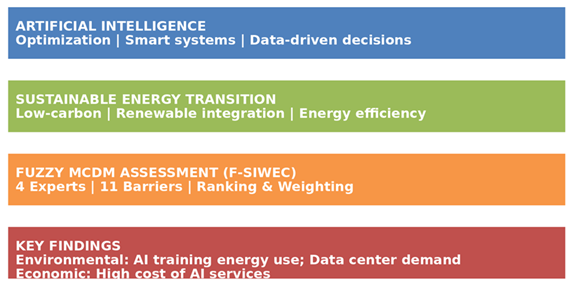
The shift toward low-carbon energy systems at an international level necessitates new actions to address socio-economic and technical barriers. In this transition, artificial intelligence (AI) plays a main role by enhancing efficiency and decision-making across the entire energy sector. This study applies a fuzzy simple weight calculation (F-SIWEC) method to systematically assess the economic and environmental barriers to unlock AI for sustainable energy transition. Data was collected from four domain experts who evaluated eleven barriers, and the adopted method was then applied to determine the relative importance of each barrier. The findings indicate that the surging energy use associated with AI training and data centers along with the rapid rise in data center electricity demand constitutes the most significant overall barriers. Within the economic dimension, the high cost of AI services emerges as the most critical constraint. The study makes a meaningful contribution to the decision sciences and management literature by offering practical insights for policymakers and concludes by outlining clear avenues for future research.
Downloads
Published
How to Cite
Issue
Section
License
Copyright (c) 2026 Mouhamed Bayane Bouraima (Author)

This work is licensed under a Creative Commons Attribution 4.0 International License.