A Discriminant Analysis of Human Development Index 2022: Analysis of Life Expectancy at Birth, Schooling, and Gross National Income per Capita
DOI:
https://doi.org/10.59543/zw5d1n16Keywords:
human development index, health, education, incomeAbstract
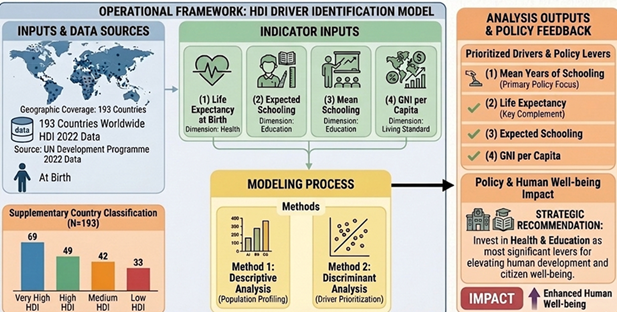
This study aimed to examine life expectancy at birth, expected years of schooling, mean years of schooling, and gross national income (GNI) per capita across four distinct Human Development Index (HDI) categories (very high, high, medium, and low) for 193 countries worldwide. The HDI 2022 data from the United Nations Development Programme was used in this study. A descriptive data analysis demonstrated a fundamental understanding of the basic information about HDI 2022. Meanwhile, a discriminant analysis was employed to examine the different HDI levels associated with the various predictors in the study. The result revealed that 69 countries are labelled as having very high HDI, 49 as having high HDI, 42 as having medium HDI, and 33 as having low HDI. The discriminant analysis revealed that mean years of schooling is the highest contributor to a country's Human Development Index, followed by life expectancy at birth and expected years of schooling. Gross national income per capita makes the least contribution to the HDI. Education and health are the most significant factors in the country's Human Development Index. The countries should recognize the importance of health and education in advancing the lives of their citizens.
Downloads
Published
How to Cite
Issue
Section
License
Copyright (c) 2026 John Raubensun Hipulan (Author)

This work is licensed under a Creative Commons Attribution 4.0 International License.