Sustainable Road Infrastructure Using Plastic Waste-Modified Asphalt: Performance Evaluation and Life-Cycle Cost Analysis
DOI:
https://doi.org/10.59543/nrcbww57Keywords:
Sustainable Infrastructure; Plastic-Modified Asphalt; Circular Economy; Road Engineering; Waste Management; Life-Cycle Cost Analysis; Environmental Sustainability; Pavement Performance;Abstract
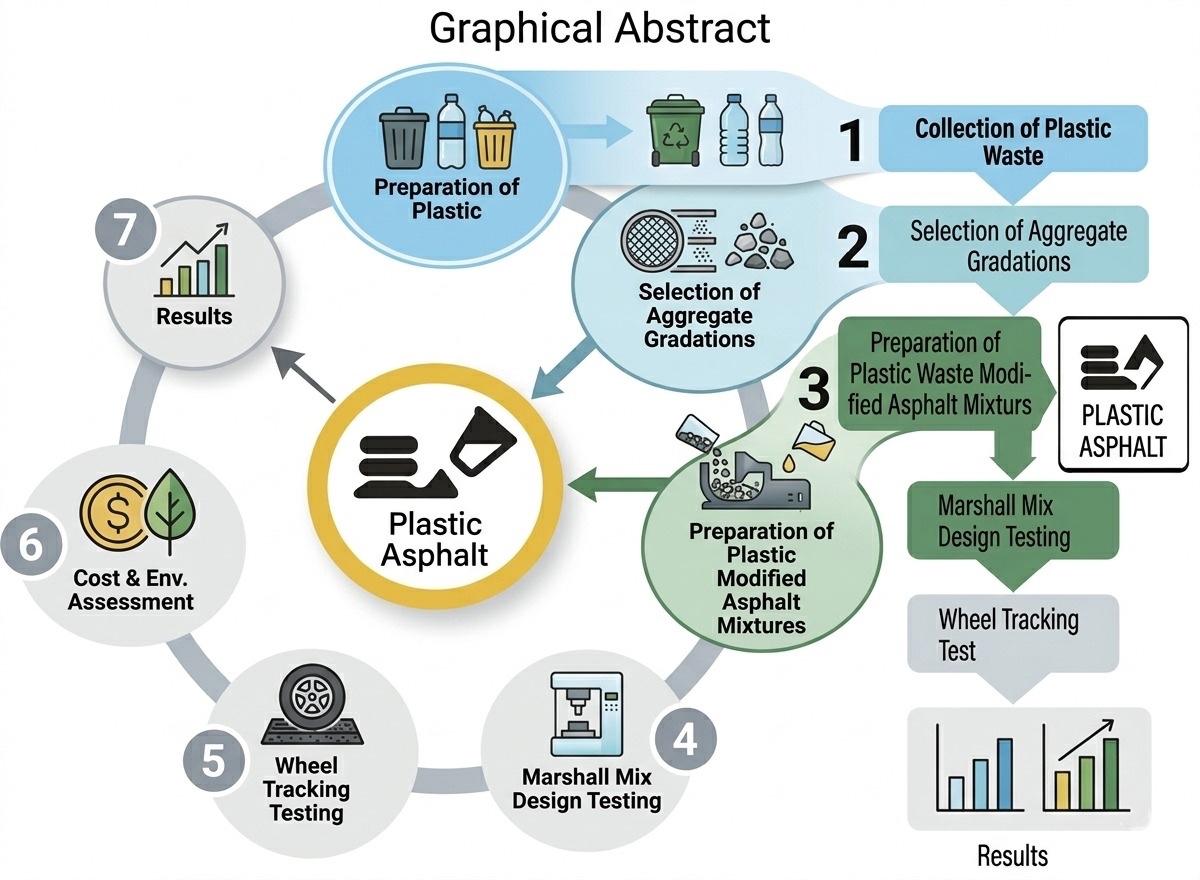
Sustainable infrastructure development requires innovative solutions that address both environmental challenges and economic efficiency. The increasing accumulation of plastic waste, coupled with the demand for durable construction materials, has encouraged the use of plastic-modified asphalt in road engineering. This study evaluates the mechanical performance and life-cycle cost benefits of bitumen mixtures incorporating varying percentages of plastic waste in Pakistan. Standard tests, including Marshall Stability and rutting resistance, were conducted to assess performance. Results indicate that a 9% plastic content significantly enhances stiffness, particle interlocking, and durability, with only 3.9 mm rutting observed after 10,000 load cycles, suggesting extended pavement life. Although higher plastic content (13%) shows moderate performance gains, optimal results were achieved at 9%. Life-cycle cost analysis reveals potential savings of approximately PKR 3.1 million per kilometer due to reduced maintenance and material replacement. The findings demonstrate that plastic-modified asphalt contributes to sustainable road construction by improving performance while mitigating plastic pollution, supporting environmentally responsible and cost-effective infrastructure development.
Downloads
Published
How to Cite
Issue
Section
License
Copyright (c) 2026 Danish Farooq, Muhammed Irtaza Hassan, Asim Farooq, Muhammad Abid, Arslan Nasir, Muhammad Haris (Author)

This work is licensed under a Creative Commons Attribution 4.0 International License.