The Role of Smart Mobility Stations in Sustainable Urban Mobility
DOI:
https://doi.org/10.59543/dahjfs72Keywords:
Smart mobility stations (SMS); electric vehicles (EVs); e-mobility; emissions; sustainability; location selection; digital integration; multimodal transport; shared mobilityAbstract
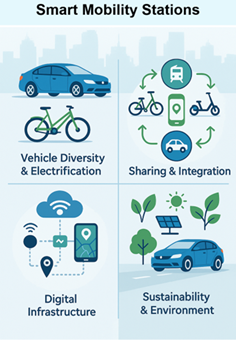
In the first decades of the 21st century, both academic interest and real-world efforts related to urban mobility and public transportation—two foundational aspects of the sustainability agenda—have notably increased. The swift evolution of technology is gradually transforming traditional urban transportation systems, paving the way for innovative solutions. Among these innovations, the proliferation of electric vehicles and the integration of digital technologies have played a pivotal role in reshaping public transit dynamics. A key development in this context is the advent of Smart Mobility Stations (SMS), which aim to revolutionize urban transport by offering flexible, inclusive, and interconnected mobility options. These platforms are influencing various facets of urban mobility, including travel behavior, multimodal transport systems, digital connectivity, environmental sustainability, and shared resource use. Distinguished by their decentralized structure and high adaptability, smart mobility stations are emerging as viable alternatives to conventional transport stations. Commonly discussed in academic literature under terms like e-mobility, smart mobility, or shared mobility, these innovations are vital for promoting sustainable transport and fostering smart urban development. This research examines the current state of smart mobility stations deployment, the challenges they face, their influence on city life, and the novel frameworks they introduce, alongside their broader societal implications. In response to the global climate crisis and the intensifying urbanization trend, sustainable transportation solutions have gained prominence. This study assesses how smart mobility stations are integrated into existing transit networks, evaluates their operational efficiency, and investigates their effects on user behavior. Through a review of academic literature and analysis of case studies, the paper highlights the environmental, economic, and social benefits of smart mobility stations, and offers strategic policy recommendations concerning digital infrastructure, governance mechanisms, and urban planning.
Downloads
Published
How to Cite
Issue
Section
License
Copyright (c) 2026 Mehmet Kilic, Francesco Pilla (Author)

This work is licensed under a Creative Commons Attribution 4.0 International License.