Sustainable Engineering Design: Accelerating Thermoelastic Stress Prediction in Hybrid SiC–Ti6Al4V Components via Machine Learning
DOI:
https://doi.org/10.59543/dbs4d790Keywords:
Centrifugal loading; Thermal gradient effects; Von Mises stress distribution; Analytical modeling.Abstract
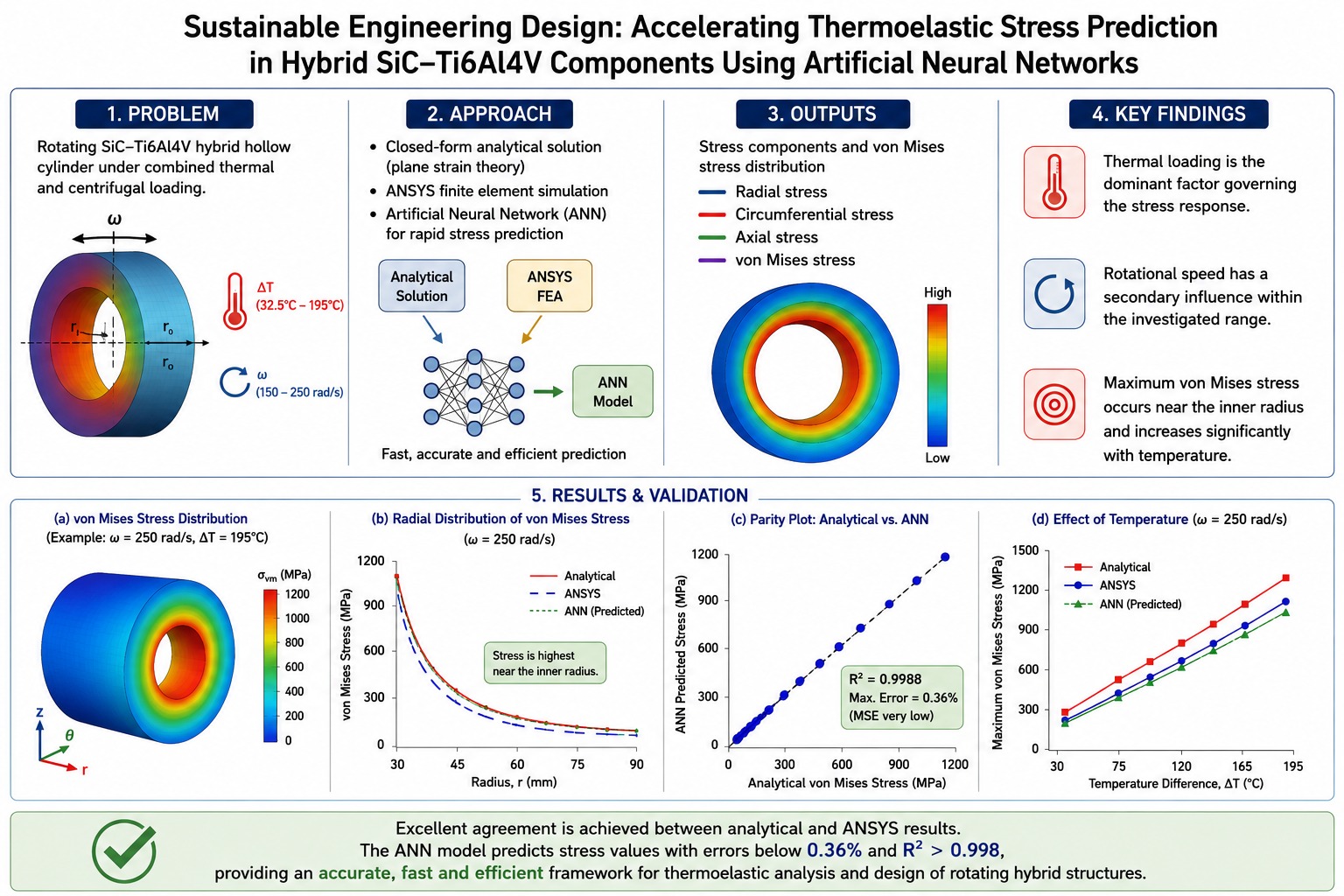
This study investigates the thermoelastic behavior of a rotating hollow cylinder composed of an equivalent SiC–Ti6Al4V hybrid material under combined thermal and centrifugal loading. A closed-form analytical solution based on plane strain theory was developed to evaluate radial, circumferential, axial, and von Mises stresses. The cylinder, with inner and outer radii of 30 mm and 90 mm, respectively, was analyzed under angular velocities of 150 and 250 rad/s and temperature differences ranging from 32.5°C to 195°C. Finite element simulations were performed using ANSYS, and an Artificial Neural Network (ANN) model was developed for rapid stress prediction. The results showed that thermal loading is the dominant factor governing the stress response, while the influence of rotational speed remains secondary within the investigated range. The maximum von Mises stress occurred near the inner radius and increased significantly with temperature. Excellent agreement was obtained between analytical and ANSYS results, and the ANN model predicted stress values with errors below 0.36% and R² values exceeding 0.998. These findings demonstrate that the proposed analytical–machine learning framework provides an accurate and computationally efficient approach for thermoelastic analysis and preliminary design of rotating hybrid structures.
Downloads
Published
How to Cite
Issue
Section
License
Copyright (c) 2026 Hüseyin Firat Kayiran (Author)

This work is licensed under a Creative Commons Attribution 4.0 International License.