Optimizing Post-Pandemic Facilities Management: A Strategic Framework for Sustainable and User-Centred University Environments
DOI:
https://doi.org/10.59543/e16dxp91Keywords:
Facilities management; User satisfaction; Digital transformation; Mediating effect; Sustainable Development Goals (SDGs)Abstract
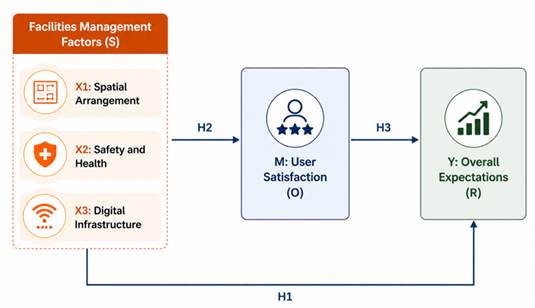
The COVID-19 pandemic has necessitated a rapid evolution in Facilities Management (FM) to foster resilient and inclusive higher education environments. While FM practices are critical to institutional sustainability, limited research explores how post-pandemic dimensions influence user satisfaction and long-term expectations. This study investigates the impact of space organisation, safety and health, and digital infrastructure on user experience in UK universities, aligning with SDG 3 (Good Health and Well-being) and SDG 9 (Resilient Infrastructure). Using a quantitative design with 100 participants, we employed robust linear regression and bootstrap mediation analysis. Findings reveal that all three dimensions significantly enhance user satisfaction, a prerequisite for SDG 4 (Quality Education), with safety and health emerging as the primary predictor. Satisfaction partially mediates the relationship between FM dimensions and future service expectations, accounting for up to 63% of the variance. By prioritizing health-oriented design and digital integration, universities can optimize campus resilience and operational performance. This research provides a strategic framework for institutions to transition toward sustainable, adaptive FM systems that support both human well-being and long-term educational excellence in the post-pandemic era.